

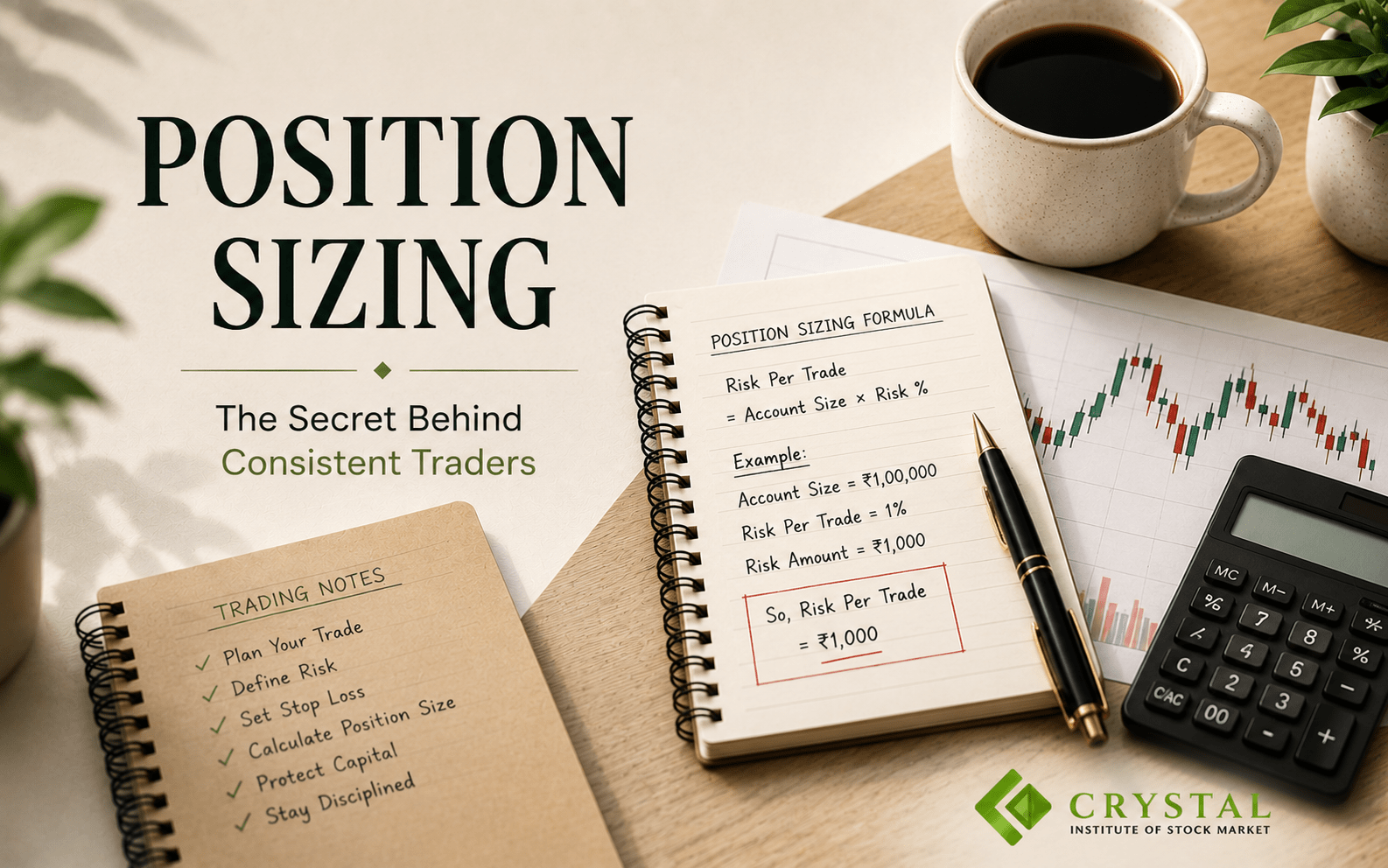
Position Sizing in Trading: The Secret Behind Consistent Traders
Most beginners believe that successful trading is all about finding the perfect stock or predicting the market correctly.
In reality, experienced traders think differently.
They know that protecting capital is far more important than winning every trade. One of the biggest reasons successful traders survive in the market for years is proper position sizing.
If you've already read our article on What is Stop Loss in the Stock Market?
What is Stop Loss in the Stock Market? https://crystal1.in/blog/what-is-stop-loss-in-the-stock-market-meaning-types-how-beginners-should-use-it
you already know that limiting losses is essential. Position sizing is the next piece of the puzzle because it decides how much capital you should put into a trade.
What is Position Sizing?
Position sizing simply means deciding how much money or how many shares you should buy before entering a trade.
Many beginners choose a stock first and then invest whatever amount they have available.
Professional traders do exactly the opposite.
They first decide how much they are willing to risk, and only then calculate the number of shares or lots they should buy.
This simple habit is one of the strongest foundations of risk management in trading.
Why Position Sizing Matters
Imagine two traders who both have ₹1,00,000.
The first trader invests the entire amount in one trade.
The second trader risks only a small portion of the capital.
If the trade goes wrong, the first trader may lose a significant part of the account. The second trader still has enough capital to continue trading and recover over time.
This is why experienced traders don't try to maximise profits on every trade—they focus on surviving long enough to let consistency work in their favour.
Your trading capital is your business inventory.
Protect it.
Position Sizing and Stop Loss Work Together
Position sizing should never be planned without a stop loss.
For example, if you're willing to lose only ₹500 on a trade, your position size should be calculated according to the distance between your entry price and your stop loss.
Without a stop loss, position sizing loses its purpose.
If you're still not familiar with stop losses, we recommend reading our beginner-friendly guide first.
What is Stop Loss in the Stock Market? https://crystal1.in/blog/what-is-stop-loss-in-the-stock-market-meaning-types-how-beginners-should-use-it
Don't Ignore Chart Structure
Many traders place stop losses randomly.
Instead, professional traders usually place them below important support levels, swing lows, or other technical levels.
If you're new to chart reading, understanding Support and Resistance will help you place more logical stop losses.
Common Position Sizing Mistakes
Many trading losses happen because of poor money management rather than poor analysis.
Some common mistakes include:
- Investing too much in one trade.
- Increasing quantity after a few winning trades.
- Trying to recover losses by taking oversized positions.
- Ignoring stop loss completely.
- Risking different amounts on every trade without a fixed plan.
These habits usually lead to emotional decisions and inconsistent performance.
How Professional Traders Think
Professional traders don't ask,
"How much profit can I make?"
Instead, they ask,
"How much am I willing to lose if this trade doesn't work?"
This small shift in thinking changes everything.
The market will always provide another opportunity.
Protecting your capital ensures you'll still be around to take it.
Final Thoughts
Many beginners spend months searching for the perfect indicator or strategy while ignoring position sizing.
The truth is that even a good trading strategy can fail without proper risk management.
Position sizing, stop loss, and trading discipline work together.
Master these basics before looking for advanced strategies.
If you're completely new to the market, we also recommend reading our beginner guide:
How Does the Stock Market Actually Work?https://crystal1.in/blog/how-to-start-stock-market-trading-as-a-beginner
At Crystal Institute of Stock Market, we believe successful trading is built on discipline, patience, and continuous learning—not shortcuts.
Disclaimer
This article is published for educational purposes only and should not be considered investment or trading advice. Investments in the stock market are subject to market risks. Please consult a SEBI-registered investment advisor or conduct your own research before making any investment decisions.
Position Sizing in Trading: The Secret Behind Consistent Traders
Learn what position sizing is, why it is essential for risk management, and how proper position sizing helps traders protect capital and trade consistently.
position-sizing-in-trading