

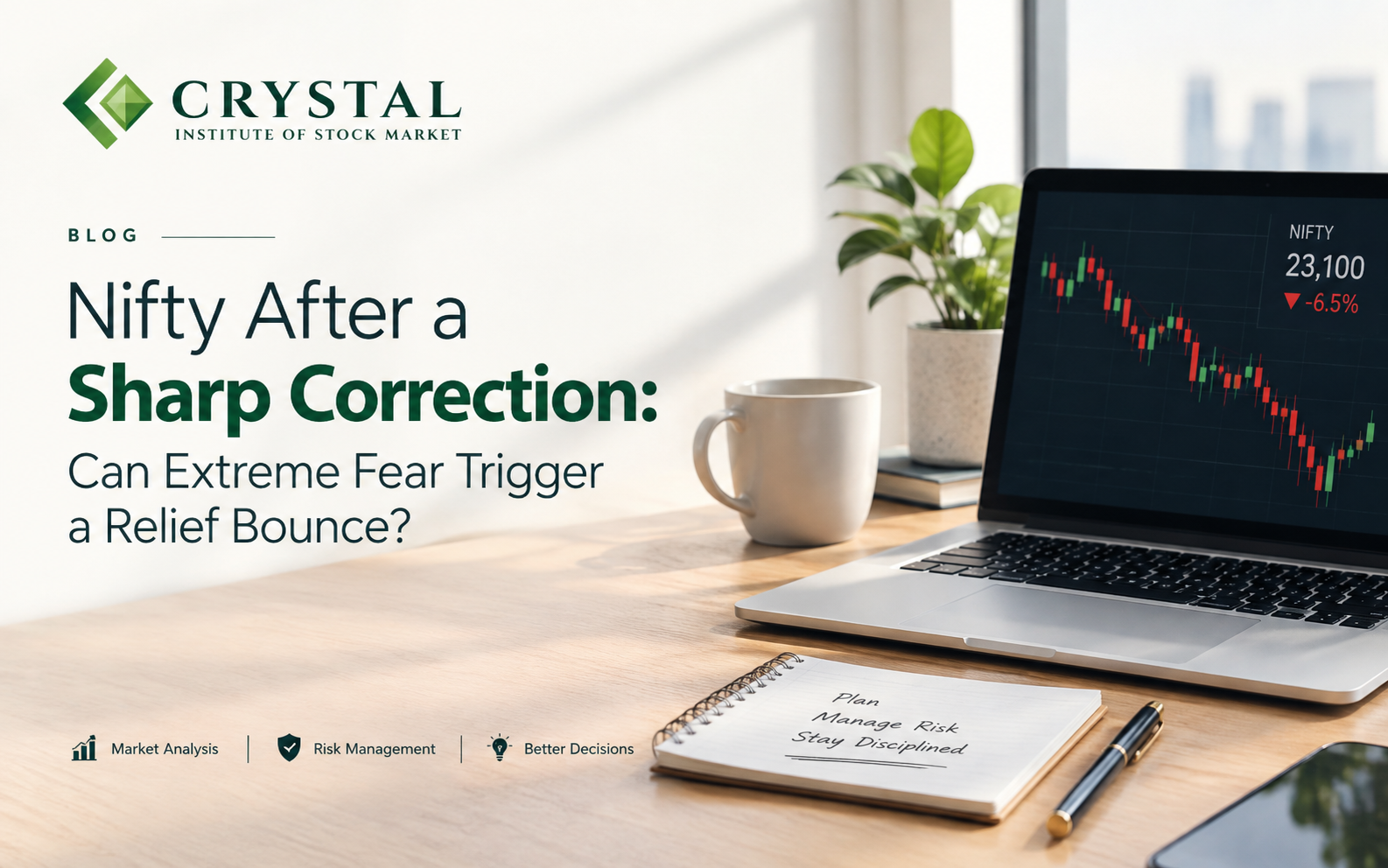
Nifty After a Sharp Correction: Can Extreme Fear Trigger a Relief Bounce?
The Indian stock market has gone through a sharp correction in recent sessions, with the Nifty falling significantly from its recent swing high near 24,700 to around the 23,100–23,200 zone.
That kind of decline naturally creates fear among investors.
But it also raises an interesting question:
When the market becomes extremely fearful after a sharp fall, can the same fear eventually create conditions for a short-term bounce?
With the US Federal Reserve's interest-rate decision scheduled for tonight, the next few trading sessions could be particularly important.
Nifty Has Already Seen a Significant Correction
Nifty's recent move has been clearly negative.
From the recent swing high around 24,700, the index has declined toward the 23,100–23,200 area.
That represents a substantial correction in a relatively short period.
When an index falls sharply, investors often become increasingly cautious. Existing positions may be reduced, fresh buying may be postponed, and negative news can have a stronger impact on sentiment.
However, after a significant fall, the market can also reach a point where selling pressure begins to lose momentum.
This does not necessarily mean that the larger trend has changed.
It simply means that the probability of a short-term recovery or technical bounce can increase if the market finds support.
Current Levels Are Important
The current Nifty zone is technically important because the index is approaching a previous support area after the recent decline.
If this support holds and buyers start returning, the market could potentially see a relief bounce in the coming sessions.
But there is an important distinction between a relief bounce and a trend reversal.
A relief bounce can happen even inside a larger downtrend.
Therefore, simply seeing Nifty rise for a few sessions should not automatically be interpreted as confirmation that the correction is over.
The market will need to show sustained strength and reclaim important resistance levels before a broader change in trend can be considered.
Market Sentiment Has Become Extremely Fearful
One of the most noticeable features of the current environment is the level of fear among market participants.
The Market Mood Index is around 10, which represents an extremely fearful sentiment environment.
Extreme fear generally means investors are highly cautious and negative about the near-term market outlook.
Interestingly, periods of extreme fear can sometimes create short-term opportunities because a significant amount of negative sentiment may already have been reflected in prices.
But there is an important lesson here:
Extreme fear does not mean the market has to bottom immediately.
Fear can remain elevated while prices continue to fall.
Therefore, sentiment should be treated as one input—not as a standalone buy signal.
The Fed Interest-Rate Decision Could Be a Major Trigger
The US Federal Reserve's interest-rate decision is the key event currently in focus.
The market reaction will depend not only on the rate decision itself, but also on what the Fed communicates about inflation, economic growth and the future path of interest rates.
For Indian equities, global risk sentiment can be particularly important during such events.
A supportive reaction from global markets could help Indian equities recover from oversold levels.
On the other hand, a negative interpretation of the Fed's statement could result in another wave of volatility.
This is why tomorrow's price action may be more informative than trying to predict the immediate reaction tonight.
Crude Oil Remains a Major Concern
There is another important factor that should not be ignored: crude oil.
Brent crude has been trading at elevated levels, around the $107–108 area recently.
For India, higher crude prices can create additional macroeconomic pressure because India imports a substantial portion of its crude oil requirement.
Higher oil prices can influence inflation, the rupee, corporate costs and India's trade balance.
Therefore, even if Nifty manages to produce a short-term bounce, the broader market picture cannot be evaluated using technical factors alone.
Global crude prices, currency movement, foreign flows, bond yields and geopolitical developments will continue to matter.
So, Can Nifty Bounce From Current Levels?
Yes, a technical or relief bounce is possible.
The reasoning is relatively straightforward:
Nifty has already experienced a sharp correction.
The index is approaching an important support zone.
Market sentiment is at extremely fearful levels.
The market appears stretched on the downside.
A major global event is approaching.
A reduction in selling pressure can trigger short-covering and fresh buying.
However, these factors do not guarantee a sustained recovery.
The market could bounce and then face selling again at higher levels.
That is why the next few sessions should be watched carefully.
Relief Bounce vs Trend Reversal
This is perhaps the most important distinction for investors and traders.
Relief Bounce
A relief bounce generally means the market recovers after a sharp decline because selling pressure temporarily reduces and buyers step in.
It can last for a few sessions or longer.
But it does not necessarily change the larger trend.
Trend Reversal
A genuine trend reversal requires stronger confirmation.
The index would generally need to regain important resistance zones, sustain higher levels and demonstrate that buyers are consistently taking control.
Therefore:
Bounce ≠ Reversal
This distinction becomes particularly important after a sharp correction.
What Should Investors Watch Next?
Instead of focusing only on whether Nifty opens higher or lower after the Fed decision, investors can watch several factors together.
1. Nifty's Reaction Around Support
Does the index hold the current support zone?
A sustained breakdown would indicate that sellers remain in control.
2. Reaction at Higher Levels
If Nifty bounces, where does it face selling?
Resistance levels can tell us whether the move is simply a recovery or something stronger.
3. Global Markets
US markets, Asian markets and overall risk sentiment could influence the opening and subsequent direction of Indian equities.
4. Crude Oil
A sustained move higher in crude would remain a concern for India.
5. USD/INR
The rupee's movement will also remain an important indicator of broader market pressure.
6. Institutional Flows
FII and DII activity can provide additional context, although flows alone should not be used to predict the next market move.
The Bigger Picture Is Still Unclear
From a short-term perspective, the market looks capable of producing a bounce.
But the bigger picture remains more complicated.
High crude prices, global uncertainty, interest-rate expectations and currency movements can continue to create volatility.
Therefore, it would be premature to conclude that one or two positive sessions have completely changed the larger market structure.
The better approach is to allow the market to confirm its next direction.
"Buy the Fear, Sell the Greed"
There is a famous market principle:
"Buy the fear, sell the greed."
The idea behind the statement is that excessive fear can sometimes create attractive opportunities, while excessive optimism can eventually lead to overvaluation and complacency.
But this principle should not be interpreted as:
Extreme fear = Buy immediately.
Markets can remain fearful for much longer than expected.
The practical lesson is to remain calm when sentiment becomes extreme and focus on price, risk and confirmation rather than emotion.
What We Are Watching at Crystal
At current levels, our view is that Nifty may have room for a technical/relief bounce in the coming sessions, particularly if the current support zone holds and the reaction to the Fed decision is constructive.
However, we are not treating this as confirmation of a major trend reversal.
The larger market picture still requires monitoring.
The next few sessions could provide better clarity through actual price action rather than assumptions.
For now, the key message is simple:
The market has fallen sharply. Fear is extremely high. Support is nearby. A bounce is possible—but confirmation matters.
Sometimes the best information comes not from predicting the next candle, but from watching how the market behaves after an important event.
Final Thought
Markets rarely move in a straight line.
After a sharp fall, there can be another fall, a sideways phase, or a sharp recovery.
The objective should therefore not be to predict every move.
Instead:
Observe. Plan. Manage risk. Let the market confirm.
Disclaimer: This article is published strictly for educational and informational purposes. It should not be considered investment advice, a recommendation, a research report, or a buy/sell call. Market views and technical observations are subject to change as market conditions evolve. Stock market investments and trading involve significant risk. Readers should conduct their own research and consult a qualified financial professional before making any investment or trading decision.
Crystal Institute of Stock Market
627, ITC Building, Majuragate, Ring Road, Surat
🌐 crystal1.in
✉️ info@crystal1.in