

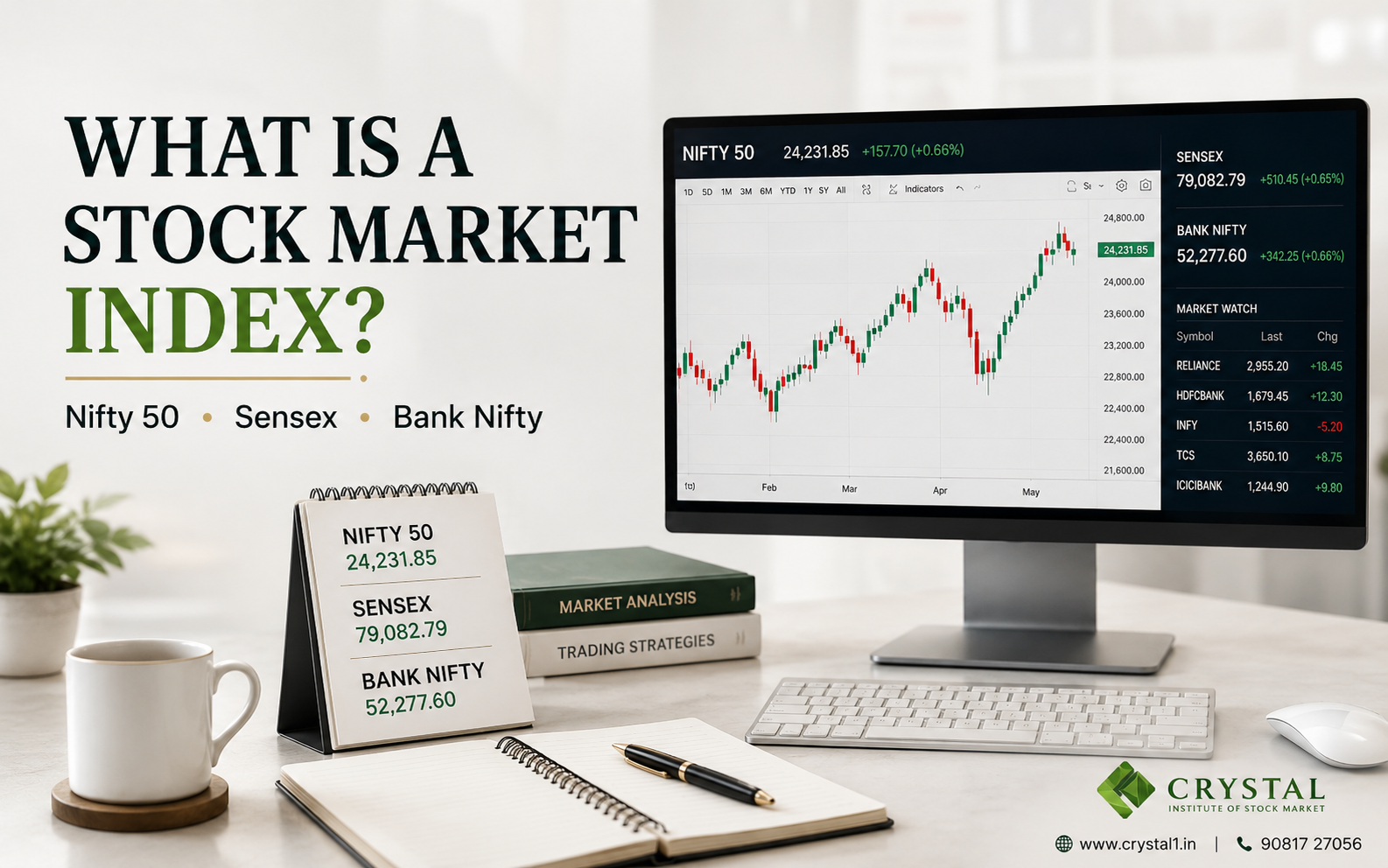
What Is a Stock Market Index? Nifty 50, Sensex & Bank Nifty Explained Simply
If you have ever watched financial news and heard phrases like “Nifty is up 200 points,” “Sensex fell 500 points,” or “Bank Nifty is showing strength,” you may have wondered what these numbers actually mean.
Are Nifty and Sensex stocks? Can you buy them directly? And why do traders pay so much attention to them?
In this article, we'll understand what a stock market index is and how some of India's most important indices—Nifty 50, Sensex and Bank Nifty—work.
What Is a Stock Market Index?
A stock market index is a measurement that tracks the performance of a selected group of stocks.
Think of it as a basket of companies representing a particular segment of the market.
Instead of looking at hundreds or thousands of individual stocks, an index gives investors and traders a quick idea of how a particular part of the market is performing.
For example, if Nifty 50 is rising, it generally indicates that the companies included in the index are performing positively overall.
However, this does not mean every stock in the market is rising.
Some stocks can fall even when the index is strongly positive, while others can rise when the index is falling.
Why Do We Need Stock Market Indices?
Imagine trying to understand the entire Indian stock market by looking at every listed company individually.
It would be extremely difficult.
Indices simplify this.
They help investors and traders:
Understand the overall market direction
Compare market performance over time
Track specific sectors
Measure portfolio performance
Develop trading and investment strategies
Understand market sentiment
This is why you will often hear market participants discussing Nifty or Sensex before discussing individual stocks.
What Is Nifty 50?
Nifty 50 is one of India's most widely followed stock market indices.
It tracks 50 large and liquid companies listed on the National Stock Exchange (NSE).
These companies come from different sectors, making Nifty 50 a broad representation of the large-cap segment of the Indian equity market.
The index includes companies from areas such as:
Banking and financial services
Information technology
Energy
Automobile
Pharmaceuticals
Consumer goods
Telecommunications
Metals and other industries
The composition of the index can change over time as companies grow, decline in importance, or no longer meet the criteria for inclusion.
Why Is Nifty 50 Important?
Nifty is widely used as a benchmark for the Indian equity market.
When someone says:
“The Indian market was positive today.”
they are often referring to the performance of major benchmark indices such as Nifty and Sensex.
Nifty is also heavily used by traders because Nifty futures and options are among the most actively traded index derivatives in India.
What Is Sensex?
Sensex is the benchmark index of the Bombay Stock Exchange (BSE).
The name comes from a combination of “Sensitive Index.”
Sensex tracks 30 large and actively traded companies listed on the BSE.
Like Nifty 50, the companies represented in Sensex come from different sectors of the economy.
Because these companies are large and influential, their price movements can have a significant impact on the index.
Nifty vs Sensex
| Nifty 50 | Sensex |
|---|---|
| Tracks 50 companies | Tracks 30 companies |
| NSE benchmark | BSE benchmark |
| Widely used for NSE market analysis | Widely used for BSE market analysis |
Both indices are useful indicators of the performance of large Indian companies.
What Is Bank Nifty?
Bank Nifty is different from Nifty 50 and Sensex because it focuses specifically on the banking sector.
It tracks major banking stocks listed on the NSE.
Because banks play a major role in the Indian economy and financial markets, Bank Nifty is one of the most closely watched sectoral indices.
Traders particularly follow Bank Nifty to understand:
Strength or weakness in banking stocks
The performance of major private and public sector banks
Financial-sector sentiment
Potential trading opportunities in index derivatives
For traders who actively trade index futures and options, Bank Nifty can be particularly important.
Why Can Nifty Rise Even When Many Stocks Are Falling?
This is an important concept for beginners.
An index is not simply an average of all the stocks in the market.
Different stocks have different weights within an index.
Larger companies generally have a greater influence on the index than smaller companies.
For example, if some heavily weighted stocks rise significantly, they can push the index higher even if several smaller stocks are declining.
This is why you should not assume:
Nifty is up = every stock is up.
Always look beneath the index to understand market breadth, sector performance and individual stock movement.
What Does It Mean When Nifty Rises 200 Points?
Suppose Nifty closes at 24,000 and moves up by 200 points.
That means the index has increased by approximately 0.83%.
The “200 points” refers to the change in the index value—not ₹200 of profit that someone automatically earns.
Your actual profit or loss depends on what you are trading.
For example, someone holding an individual stock does not automatically make money just because Nifty rises.
Similarly, someone trading Nifty derivatives will have a profit or loss depending on their position, entry price, contract size, and other factors.
Can You Buy Nifty 50 or Sensex Directly?
You cannot buy the index itself like you buy shares of a company.
However, there are financial products designed to track indices, such as index mutual funds and exchange-traded funds (ETFs).
Traders can also participate through index derivatives such as futures and options, subject to applicable exchange and broker rules.
The important point is to understand the difference between the index itself and financial products that track or derive their value from the index.
Nifty, Sensex and Bank Nifty: Which One Should You Watch?
There is no single answer.
It depends on what you are trying to understand.
For overall large-cap market direction
Nifty 50 is one of the most commonly followed benchmarks.
For the BSE market
Sensex is the primary benchmark.
For banking-sector strength
Bank Nifty can provide additional insight.
Many traders monitor more than one index because comparing them can reveal useful information.
For example, if Nifty is rising but Bank Nifty is consistently weak, it may indicate that the banking sector is not participating strongly in the broader market move.
Why Traders Shouldn't Trade an Index Blindly
One of the biggest mistakes beginners make is treating an index level as a guaranteed trading signal.
For example:
“Nifty is at support, so I should buy.”
Support and resistance can help traders structure a trade, but they do not guarantee what happens next.
A level can break.
A breakout can fail.
A trend can reverse.
This is why index analysis should ideally be combined with price action, volume, market structure and proper risk management.
You can learn more about these concepts through our other educational articles.
Final Thoughts
A stock market index is essentially a market measurement tool.
Nifty 50 gives us a broad view of major companies listed on the NSE, Sensex tracks 30 major companies on the BSE, while Bank Nifty focuses specifically on the banking sector.
Understanding these indices is an important first step for anyone learning the stock market.
But remember—an index only tells you what the market is doing at a broad level. To become a better trader or investor, you need to understand what is happening underneath that number.
The goal should not be to simply follow Nifty or Sensex every day.
The goal should be to understand why they are moving, which sectors are participating, and how that information fits into your own strategy and risk management process.
Continue Learning
If you're building your stock market knowledge from the ground up, explore these Crystal Institute articles next:
How Does the Stock Market Actually Work?
Demat Account vs Trading Account: What's the Difference?
Introduction to Price Action Trading
What Is Risk Management in Trading?
Support and Resistance Explained for Beginners
Disclaimer
This article is published solely for educational and informational purposes. It does not constitute investment advice, trading advice, a recommendation, research report, or a buy/sell call. Stock market investments and trading involve market risks. Readers should conduct their own research and, where appropriate, consult a SEBI-registered investment advisor before making investment decisions.
stock market index
what-is-stock-market-index-nifty-sensex-bank-nifty
Stock Market, Nifty 50, Sensex, Bank Nifty, Stock Market Basics, Trading Basics, Indian Stock Market, Nifty Analysis