

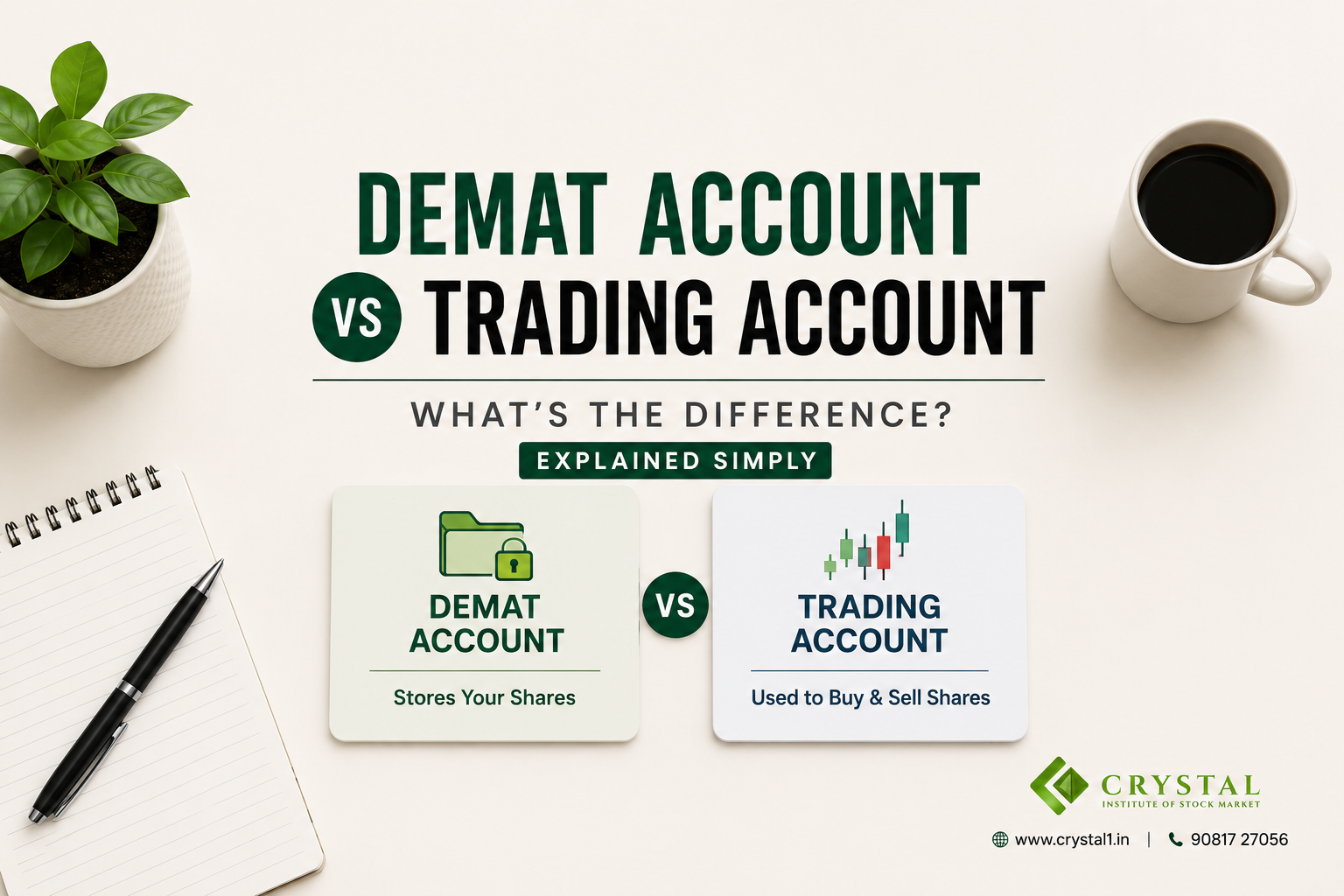
Demat Account vs Trading Account: What's the Difference? (Explained Simply)
If you're planning to invest in the stock market, you've probably come across two terms repeatedly — Demat Accountand Trading Account.
For many beginners, these terms sound confusing. Some people even believe they are the same account with different names.
The truth is, they perform two completely different functions, and understanding this difference is one of the first lessons every new investor should learn.
Let's simplify it.
What is a Demat Account?
A Demat Account (Dematerialized Account) is like a digital locker where your shares and securities are stored safely in electronic form.
Years ago, investors received physical share certificates. Today, everything is digital, and a Demat Account holds your investments securely.
Whenever you buy shares, they are credited to your Demat Account. When you sell them, they are debited from the same account.
Think of it as your digital warehouse for investments.
Apart from shares, a Demat Account can also hold:
- Equity Shares
- ETFs
- Bonds
- Government Securities
- Mutual Funds (on certain platforms)
- REITs and InvITs
What is a Trading Account?
A Trading Account is the account you use to buy and sell shares on the stock exchange.
It acts as a bridge between you and stock exchanges like NSE and BSE.
Without a Trading Account, you cannot place buy or sell orders in the market.
Simply put, your Trading Account executes transactions, while your Demat Account stores the shares.
Demat Account vs Trading Account
| Demat Account | Trading Account |
|---|---|
| Stores your shares electronically | Used to buy and sell shares |
| Works like a digital locker | Works like a transaction account |
| Holds investments safely | Places orders on NSE & BSE |
| Shares remain here until sold | Used only during buying and selling |
A Simple Real-Life Example
Imagine you're buying a new smartphone online.
The shopping app helps you place the order.
Your home is where the phone is delivered and stored.
In the stock market:
- Trading Account = Shopping App
- Demat Account = Your Home
The Trading Account helps you buy or sell.
The Demat Account stores what you've purchased.
That's why both accounts work together.
Do You Need Both Accounts?
Yes.
If you want to invest or trade in shares listed on the Indian stock market, you'll generally need both a Trading Accountand a Demat Account.
Today, most stock brokers offer them together, making the account opening process quick and convenient.
Can You Have a Demat Account Without Trading?
Yes.
If you only want to hold securities that have already been transferred or don't plan to trade immediately, a Demat Account can exist without actively using a Trading Account.
However, if you wish to buy or sell shares on the stock exchange, you'll need a Trading Account.
Common Mistakes Beginners Make
Many first-time investors make avoidable mistakes.
Some of the most common ones include:
- Assuming Demat and Trading Accounts are the same.
- Opening an account without understanding brokerage charges.
- Choosing a broker only because of advertisements.
- Ignoring annual maintenance charges (AMC).
- Starting trading before learning the basics.
A little knowledge at the beginning can prevent many costly mistakes later.
Crystal Insight 💎
Opening a Demat and Trading Account is easy.
Learning how to use them wisely is what truly matters.
Many beginners focus on opening an account within minutes but spend very little time understanding risk, market behaviour, and investing principles.
A strong foundation is always more valuable than a fast account opening process.
Key Takeaways
- A Demat Account stores your shares electronically.
- A Trading Account is used to buy and sell shares.
- Both accounts perform different functions but work together.
- Most brokers allow you to open both accounts simultaneously.
- Understanding the difference is an important first step before entering the stock market.
Frequently Asked Questions
Can I buy shares without a Demat Account?
No. Shares are held electronically, so a Demat Account is required to receive and store them.
Can I trade without a Trading Account?
No. A Trading Account is necessary to place buy and sell orders on the stock exchange.
Is one account enough?
No. For equity investing and trading, both accounts generally work together.
Can I have multiple Demat Accounts?
Yes. Investors can open multiple Demat Accounts with different brokers, subject to regulatory guidelines.
Which account stores my shares?
Your shares are always stored in your Demat Account.
Final Thoughts
Understanding the difference between a Demat Account and a Trading Account is one of the first steps in your stock market journey.
Before focusing on stock tips or trading strategies, take time to learn the basics. A clear understanding of these fundamental concepts will help you make more informed decisions as you progress in the market.
Remember, successful investing starts with knowledge—not speed.
Continue Your Learning
If you found this article helpful, continue your learning with these beginner-friendly guides:
➡️ How Does the Stock Market Actually Work? (Published)
➡️ What is NSE & BSE? (Coming Soon)
➡️ Market Orders vs Limit Orders (Coming Soon)
➡️ Technical Analysis Explained (Coming Soon)
Learn with Crystal Institute of Stock Market
Whether you're a complete beginner or someone looking to strengthen your understanding of the stock market, Crystal Institute of Stock Market offers structured learning designed to help you build confidence step by step.
🌐 Website: www.crystal1.in
📞 Contact: +91 90817 27056
📍 Offline Classroom Training – Surat
Disclaimer
This article is published for educational and informational purposes only. It should not be considered investment advice, financial advice, or a recommendation to open an account with any particular broker. Investments in the stock market are subject to market risks. Please conduct your own research or consult a qualified financial professional before making investment decisions.
Demat Account, Trading Account, Stock Market Basics, Beginner Guide, NSE, BSE, Investing, Trading, Indian Stock Market, Crystal Institute of Stock Market
demat-account-vs-trading-account